Original Article
Does the Teylers white-tailed eagle belong to the Tiglian avifauna of the Netherlands?
Rick de Graaf1, Anne S. Schulp1,2,3, Bertil van Os4 and Dick Mol5
1Department of Earth Sciences, Faculty of Geosciences, University of Utrecht, Utrecht, the Netherlands; 2Naturalis Biodiversity Center, Leiden, the Netherlands; 3Teylers Museum, Haarlem, the Netherlands; 4Cultural Heritage Agency of the Netherlands, Amersfoort, the Netherlands; 5Mammoet Laboratorium, Historyland, Hellevoetsluis, the Netherlands
Abstract
The clay pits of Tegelen, located near Venlo, Limburg Province, the Netherlands, are known for their terrestrial mammalian fauna of Tiglian age. In 1953, poorly documented but presumably Tiglian-aged bird remains in the Teylers Museum Tegelen collection were identified and described as a white-tailed eagle (Haliaeetus albicilla) by ornithologist G.C.A. Junge. The non-characteristic fossilisation of the material however, prompted us to apply 14C-dating and XRF-analysis (X-ray fluorescence), to verify whether the white-tailed eagle indeed was part of the Tiglian Tegelen avifauna. The 14C-dating firmly places the fossil in the Holocene, and the XRF fingerprint of the white-tailed eagle material differs significantly from the Tegelen locality material. Therefore, we can remove, based on the fossil record, the white-tailed eagle from the faunal list of the Tiglian of Tegelen.
Keywords: Early Pleistocene; Haliaeetus; Tegelen; XRF
Cite this article: Rick de Graaf et al. Does the Teylers white-tailed eagle belong to the Tiglian avifauna of the Netherlands? Netherlands Journal of Geosciences, Volume 105, e14649. https://doi.org/10.70712/NJG.v105.14649
Copyright: © The Author(s), 2026. Published by the Netherlands Journal of Geosciences Foundation. This is an Open Access article, distributed under the terms of the Creative Commons Attribution licence (https://creativecommons.org/licenses/by/4.0/), which permits unrestricted re-use, distribution and reproduction, provided the original article is properly cited.
Received: 5 June 2026; Revised: 28 July 2026; Accepted: 21 September 2026; Published: 6 November 2026
Corresponding author: Rick de Graaf, Email: r.r.degraaf@students.uu.nl
Competing interests and Funding: The authors declare none.
Introduction
The Tiglian is a substage of the Early Pleistocene, corresponding with the Gelasian. The ‘classical type locality’ of the Tiglian is exposed in clay pits around the namesake village of Tegelen, near the city of Venlo, Limburg Province, the Netherlands. The flora and fauna recovered from the Tegelen locality encompasses a large diversity of taxa, both from glacials and interglacials (Watanabe et al., 2023; Zagwijn, 1998). For example, the southern mammoth Mammuthus meridionalis (Nesti, 1825) and the giant beaver Trogontherium cuvieri Fischer, 1814, are characteristic species for the Tegelen locality (Mol & Van Meijel, 2025). The fauna and flora of the Tegelen locality are internationally referenced as it records the biodiversity of the Early Pleistocene ecosystems of Western Europe in exquisite resolution (Delson et al., 2024).
Teylers Museum, located in Haarlem, the Netherlands, holds a sizable collection of fossil remains from the Tegelen quarries. The collection is generally well documented. However, in the first half of the 20th century several boxes of poorly documented material were encountered in the collection (Van Regteren Altena, 1951), including the box with the material that sparked the present research, and this short contribution to our knowledge of the Tiglian fauna of Tegelen.
In 1978, paleo-artist Ben Collet painted a large canvas (4.5 m × 2 m) on what the Tiglian type area would have looked like some 2 million years ago. The work was commissioned by the Rijksmuseum van Geologie en Mineralogie (RGM) (Figure 1A). The painting was informed in detail by scientific findings of faunal and floral assemblages, and the process was supervised by M. Freudenthal, H.J.W. Schalke and E. van der Wilk, palaeontologists and geologists with the RGM, as well as by W.H. Zagwijn with the Wetenschappelijk Laboratorium, Rijks Geologische Dienst. According to Schalke and Van der Wilk, the birds on the painting by Ben Collet (1978) represent the white-tailed eagle Haliaeetus albicilla (Linnaeus, 1758) (Schalke & Van der Wilk, 1994). Curiously though, as shown in close-up (Figure 1B), the characteristic white tail that the white-tailed eagle is named after, is conspicuously absent. Moreover, nor does the relatively long neck, and, more generally, the silhouette, correspond to Haliaeetus at all. Rather, these two birds appear much more duck-like. The painting by Ben Collet is currently held in the collection of the Botanische Tuin Jochumhof (Botanical Garden Jochumhof) in Steyl, the Netherlands. An earlier attempt at reconstructing the environment of the Tegelen locality was carried out by cartographer and professional artist J. F. Obbes (Schreuder, 1943) (Figure 1C) – and although Dubois’ work on the Tegelen fauna is mentioned, the eagle is conspicuously absent in the description by Schreuder (1943) of the work, notwithstanding the bird silhouettes in the background (Figure 1D). Given the fact that the Tegelen ecosystem was otherwise described in great detail, we may consider this absence of reference to birds of prey in the 1943 description as an additional indication that Dubois did not consider this material to be of Tegelen origin.
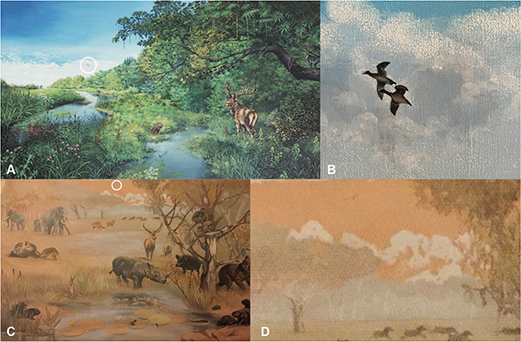
Figure 1. Environmental reconstructions of the Tegelen locality, depicting Tiglian avifauna of Tegelen. A: Environmental reconstruction, 1978 by B. Collet; B: Close-up from (A), depicting Tiglian avifauna; C: Watercolour painting, 1943, by J. F. Obbes; D: Close-up from (C), with possible bird-of-prey.
In March 2024, our colleague, Vrije Universiteit Amsterdam emeritus professor Bert Boekschoten, noted that the remains of the white-tailed eagle in the Teylers collection do not share the characteristic appearance of other vertebrate remains from the Tegelen locality. Characteristically, fossil vertebrate material from the Tegelen clay pits has a hint of clay at the bone surface, and none of this was visible in the Haliaeetus material. This observation on taphonomic dissimilarity sparked our interest, and with the present contribution we aim to elucidate whether the H. albicilla material in the Teylers Museum Tegelen collection was indeed part of the Tiglian avifauna of the Netherlands, or rather only considered as such because of a previous lapse in documentation.
Materials
When C.O. van Regteren Altena, professor in Medieval archaeology at the University of Amsterdam, took over the collection from C. Beets, a palaeontologist with expertise in Cenozoic molluscs from Indonesia, in 1946, the Tegelen collection of the Teylers Museum was only partially labelled/documented (Van den Hoek Ostende & De Vos, 2006). Furthermore, several wooden boxes and a basket were found to contain undocumented fossils, first acquired by Professor Eugène Dubois in 1913 (Van Regteren Altena, 1951). The white-tailed eagle remains were found in one of these undocumented baskets and accessioned in the Tiglian collection by C.O. van Regteren Altena (Junge, 1953). The first extensive description of the Teylers H. albicilla was published by G.C.A. Junge (1953) (Figure 2). The remains consist of:
| - right humerus | (TM F 15879) |
| - two fragments of the left humerus | (TM F 15880) |
| - left ulna | (TM F 15881) |
| - left femur | (TM F 15882) |
| - right femur | (TM F 15883) |
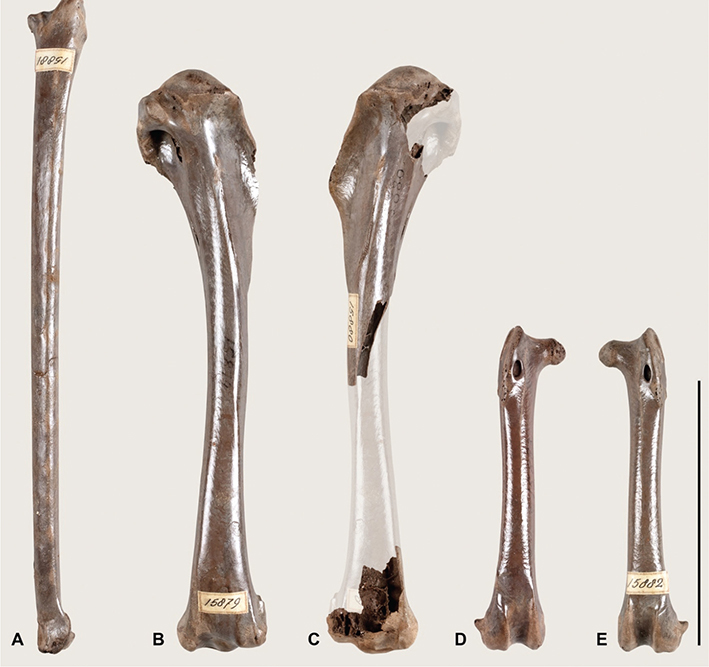
Figure 2. The skeletal remains of the white-tailed eagle (Haliaeetus albicilla) in the Tegelen Collection of the Teylers Museum, Haarlem. A: Left Ulna, TM F 15881, cranial view; B: Right Humerus, TM F 15879, cranial view; C: Left Humerus, proximal and distal portions, TM F 15880, cranial view; D: Right Femur, TM F 15883, cranial view; E: Left Femur, TM F 15882, cranial view. Scale bar: 10 cm.
Methods
In order to establish the age and to verify the origin of the Teylers Museum’s H. albicilla specimen we aimed to explore multiple independent lines of evidence. Besides research on the historical background, already summarised in the introduction, we also documented differences in taphonomic appearance, performed 14C-dating of a selection of the white-tailed eagle’s remains, and compared the XRF spectra of the present specimen with the spectra of undisputed Tegelen material.
To determine the radiometric age of the H. albicilla specimen, a sample of the left humerus was removed and sent to the Centrum voor Isotopenonderzoek (CIO, Centre for Isotope Research), Groningen, for 14C analysis. The sample was processed following the CIO in-house protocol.
As XRF analysis can be helpful in provenancing fossils (e.g. Gil-Delgado et al., 2025 and references therein), a handheld-XRF was used to determine if the stoichiometry of the H. albicilla remains were similar to the stoichiometry of fossils of undisputed Tegelen provenance. Firstly, a selection was made of material with fully documented, undisputed provenance that properly represented the range of preservation of the Tegelen locality fossils. No avifauna of the Tiglian of Tegelen is known, therefore we have selected non-avian material instead. Together with a selection of the Teylers Museum’s white-tailed eagle remains this material was analysed at the Rijksdienst voor het Cultureel Erfgoed (RCE, Cultural Heritage Agency of the Netherlands) in Amersfoort. Material used for XRF-analysis is listed in Table 1. Analyses were carried out using a Thermo Scientific Niton XL5+ energy-dispersive hand-held XRF analyser, equipped with a silicon drift detector and a portable test stand. The Cu/Zn-mining mode was used, with a measuring time of 80 seconds, using 4 sequential energy settings: Light range (Mg to Cl) at 8 kV 200 mA, low range (K to Ti) at 20 kV 100 mA, main range (V to Ag including L-lines for Pb) and high range (Cd to Ba) both at 50 kV, 40 mA. Since factory calibrations are a potentially serious source of error when using HH XRF, the machine calibration was checked and adapted using a set of 14 powdered ISE standard samples (www.wepal.nl). Accuracy was tested using the BAMS005B standard (available on request with BvO).
Results, discussion and conclusion
The radiometric age of the white-tailed eagle was found to be between 9861 and 9449 BCE within the 95.4% probability interval (Table 2). This means that the remains of the Teylers museum’s white-tailed eagle are clearly of Holocene age. The XRF-analysis yielded a clear difference in the material composition between the Tegelen fossils and the white-tailed eagle specimen (Table 3 & Figure 3). During diagenesis, the Tegelen fossils absorbed trace metals such as uranium, thorium, and yttrium from the surrounding clays. In contrast, the white-tailed eagle specimen shows no such enrichment. As both mammal and avian bones are made up by hydroxy-apatite and collagen, their initial inorganic composition is quite similar and therefore cannot explain the found differences between the Tegelen mammal bones and the white-tailed eagle remains.
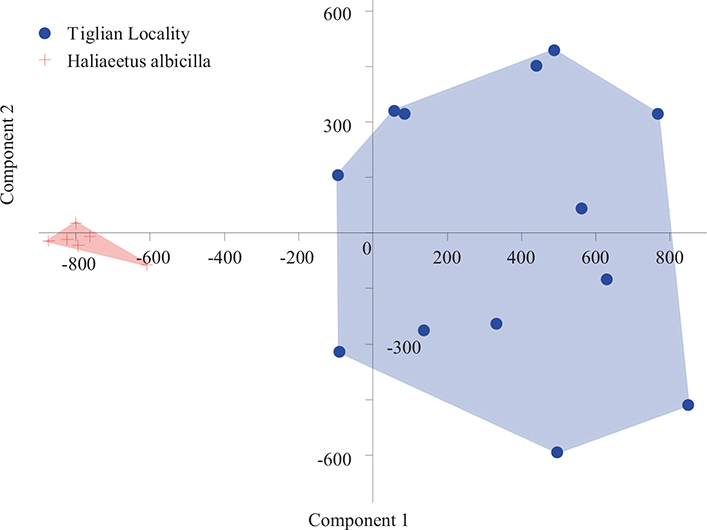
Figure 3. PCA of the Tegelen locality collection, blue indicating Tegelen locality material, red indicating H. albicilla material. The figure clearly shows that material pertaining to the Tegelen locality differs in stoichiometry from the H. albicilla material.
The remains of the Teylers Museum’s white-tailed eagle specimen are clearly not of Tiglian age after all. The Tegelen locality is internationally recognised and referenced, making a valid and up-to-date overview of its biodiversity all the more important. Considering the confounded historical record keeping, and the obvious difference in state of fossilisation between the white-tailed eagle and the Tegelen material, our 14C and XRF analyses confirm that the Teylers Museum’s H. albicilla is of Holocene age and very different in composition from unequivocal Tegelen material. We therefore find that the white-tailed eagle should be removed from the Tiglian faunal list. The actual provenance of this material remains uncertain.
Acknowledgements
Our gratitude goes out to Tim de Zeeuw for guidance through the Tegelen collection as well as its historical background at Teylers museum. Emeritus professor at VU Amsterdam, Bert Boekschoten, brought the white-tailed eagle mystery to our attention. Many thanks to the staff of the Jochumhof, Steyl, for providing the close-up photograph of the Collet painting, to Henk Schalke, Oegstgeest, for providing insightful commentary and literature, to Dylan Bastiaans (Natuurhistorisch Museum Maastricht) for his help with other Tiglian paleo-art, to Vanessa Timmermans, Teylers Museum, for photography of the white-tailed eagle skeletal elements, to Bas Engels for compiling the plate with the various Tegelen skeletal remains of the white-tailed eagle, and to the anonymous reviewers that helped improve this manuscript.
Authors’ declarations
CRediT author statement – Conceptualisation: DM, ASS, RdG; Formal analysis: RdG; Investigation: all authors; Methodology: all authors; Project Administration: RdG, ASS, DM; Resources: BvO; Validation: ASS, DM; Visualisation: RdG, ASS; Writing–original draft: RdG; Writing–review and editing: all authors.
References
| Delson, E., Faure, M. & Guérin, C., 2024. Senèze: life in central France around two million years ago. Cham: Springer. |
| Fischer, G., 1814. Zoognosia tabulis synopticis illustrata. Quadrupedum reliquorum, Cetorum et Monotrymatum descriptionem continens. Volumen tertium. Typis Nicolai Sergeidis Vsevolozsky xxiii + 605 pp. https://www.biodiversitylibrary.org/page/29130062 |
| Gil-Delgado, A., Ibáñez-Insa, J., Sellés, A., Delclòs, X., Galobart, À., Reolid, M., Cruset, D., Álvarez, S. & Oms, O., 2025. Noninvasive elemental XRF characterization of mudstone Lagerstätten for provenance identification: advantages and limitations. Palaeontologia Electronica 28(1): a3. DOI: 10.26879/1415 |
| Junge, G.C.A., 1953. Fossil bones of a white-tailed eagle, Haliaeetus albicilla (L.) from the Tegelen clay. Communicated by Prof. H. Boschma at the meeting of May 30, 1953. Leiden: Rijksmuseum van Natuurlijke Historie, pp. 263–264. |
| Mol, D. & Van Meijel, T., 2025. Tiglienconferentie 2025 samenvatting van de lezingen. Tiglienconferentie 2025. Steyl: Botanische Tuin Jochumhof Steyl (L). |
| Nesti, F., 1825. Sulla nuova specie di elefante fossile del Valdarno all’ Illustrissimo Sig. Dott. Prof. Ottaviano Targioni Tozzetti (Lettere sopra alcune ossa fossili del Valdarno non per anco descritte). Nuovo Giornale di Lettere 11(24): 195–216. |
| Schalke, H.J.W.G. & Van der Wilk, E., 1994. Collet’s 1978 painting: a palaeoenvironmental reconstruction of the Tiglian (Lower Rhenish Bight, SE Netherlands). Mededelingen Rijks Geologische Dienst 52: 167–173. |
| Schreuder, A., 1943. Het landschap van Tegelen. Natuurhistorisch Maandblad 32: 64–66. |
| Van den Hoek Ostende, L. & De Vos, J., 2006. A century of research on the classical locality of Tegelen (Province of Limburg, The Netherlands). Courier Forschungsinstitut Senckenberg 256: 291–304. |
| Van Regteren Altena, C.O., 1951. Systematic catalogue of the palaeontological collection: seventh supplement. Vertebrata from the Pleistocene Tegelen clay, Netherlands. Haarlem: Teylers Museum, pp. 1–19. |
| Watanabe, Y., Abe-Ouchi, A., Saito, F., Kino, K., O’ishi, R., Ito, T., Kawamura, K. & Chan, W.-L., 2023. Astronomical forcing shaped the timing of early Pleistocene glacial cycles. Communications Earth & Environment 4: 113. DOI: 10.1038/s43247-023-00765-x |
| Zagwijn, W.H., 1998. Borders and boundaries: a century of stratigraphical research in the Tegelen-Reuver area of Limburg (The Netherlands). Mededelingen Nederlands Instituut voor Toegepaste Geowetenschappen TNO 60: 19–34. |